


The tab Tasks Displays tasks automatically created for case management based on the configuration made in the Admin console. You can also add tasks manually; To do this, click the New Task.

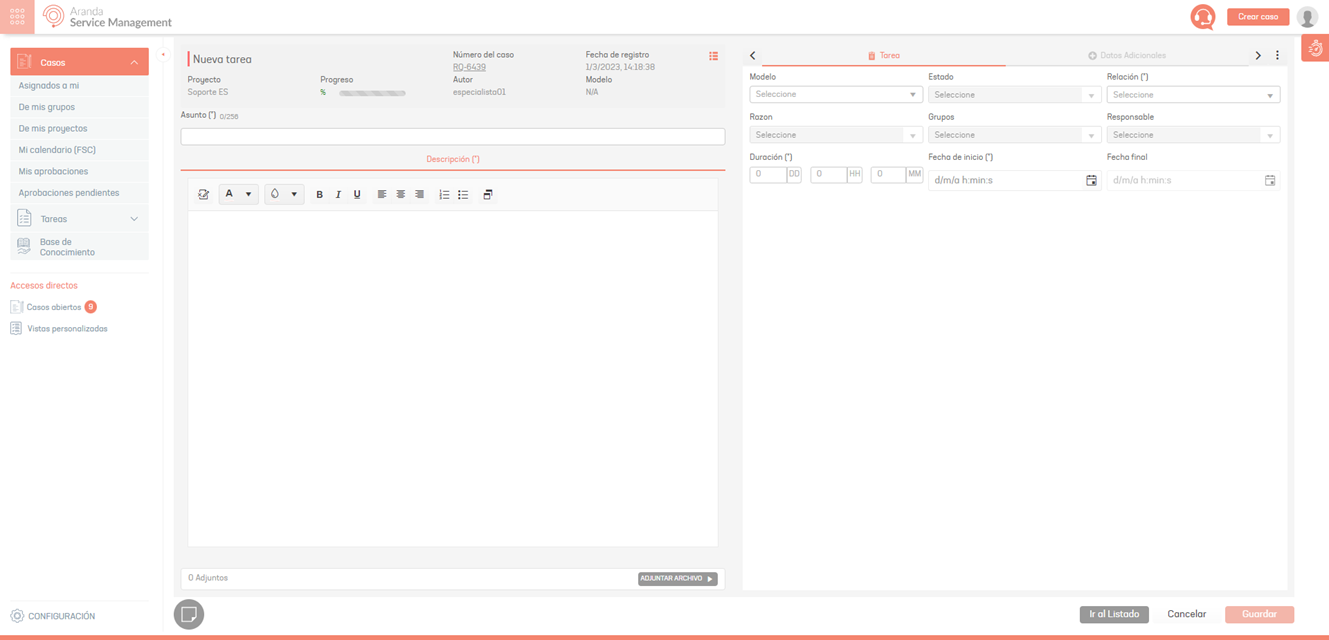
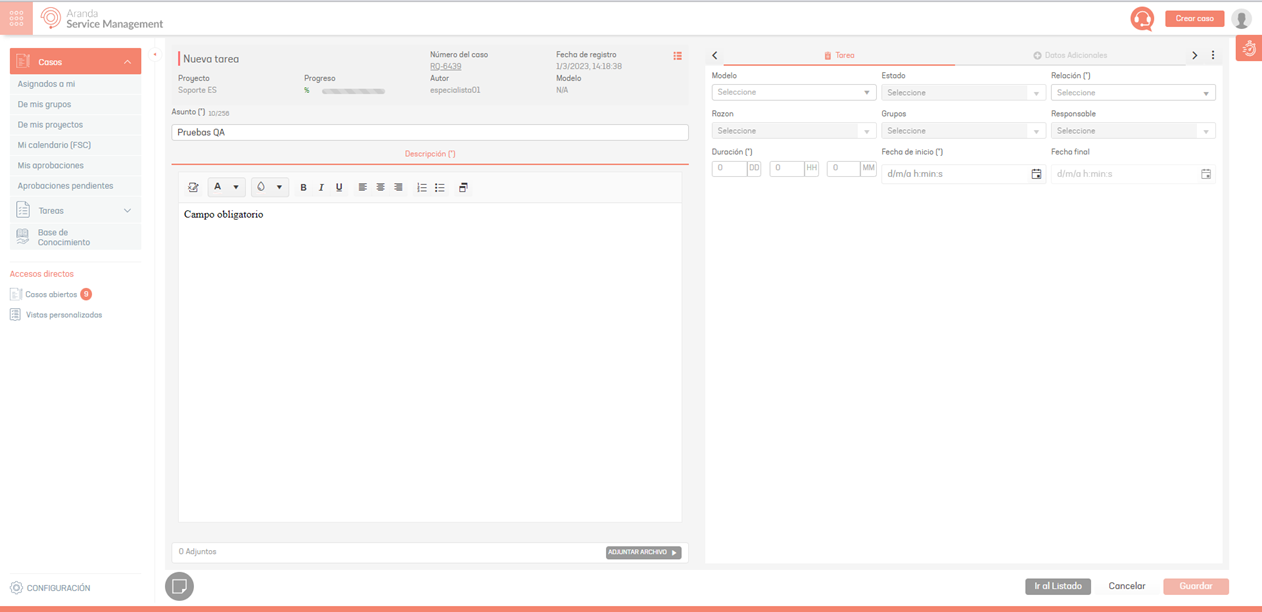
The form will appear with the following Affair, Description, Model, State, Relation, Reason, Responsible Group and Responsible. If the chosen model does not have defined times, they are enabled for editing Duration and Start Date, while End date remains locked, as it results from the calculation between the duration, the start date, and the calendar of the parent case. Once the information has been entered in the tabs Task and Additional Data, click Save.
The task will be in edit mode, and you will be able to modify the information in the forms displayed in each tab on the right side of the screen.
⚐ Notes:
- When creating or editing a task, the start date should take into account the time zone of the specialist recording it. Thus, if the computer on which the task was created does not correspond to the specialist’s time zone, when you save that date, it will be recorded with the specialist’s time zone, even if the computer’s time is displayed in the console.
- The duration and start date fields will only be editable at the creation and initial status of the task.
- The end date field is calculated according to the time zone of the calendar assigned to the case, allowing this field to be displayed on a non-working date and time.
- If in the ASMSAdministrator The Recalculate successor task dates For the task model, when you close a predecessor task, the start date of the successor task will automatically adjust to the actual end date of the predecessor task. View Task Template.
Example: If the calendar was set to time zone -3 Brasilia and a task is created with a specialist in Bogota, the calendar for Bogota is run two hours later.
The tab Relations Displays the predecessor and successor tasks based on the flow configured in the Admin console.
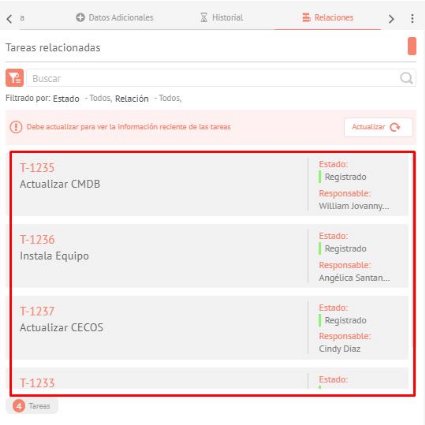
The filter icon allows you to filter the list by successor, predecessor, open, and closed tasks.

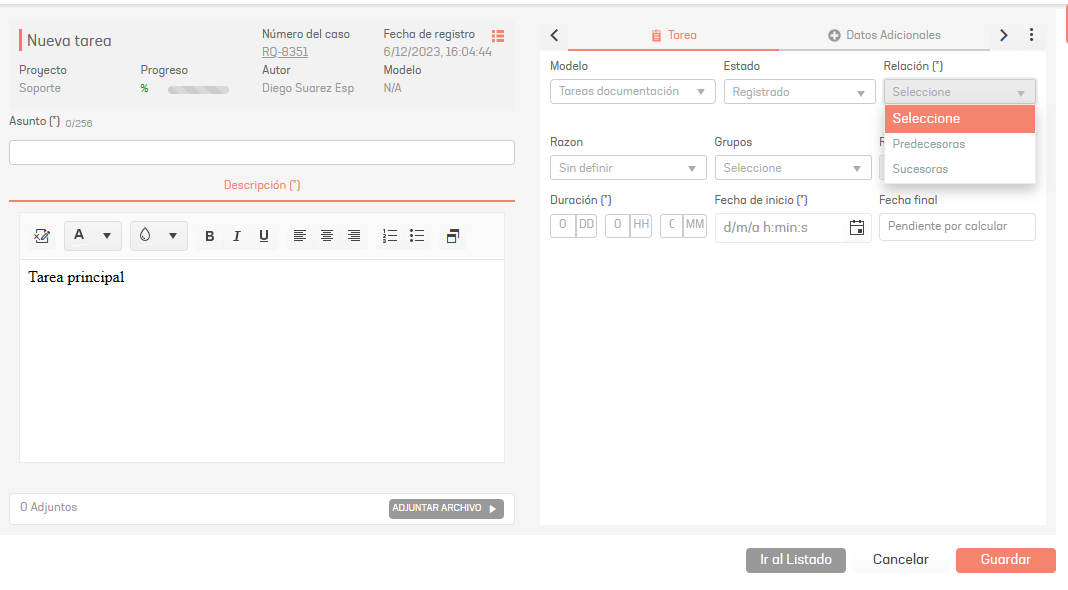
You can create related tasks and define whether they will be successors or predecessors during task creation.
1. Open an existing task in the case. 2. Above the three dots at the top right, select the option Relations. 3. Click the New task. 4. When you select the model, the other fields of the form are unlocked and when you expand the Relation, you can select between successor or predecessor options.
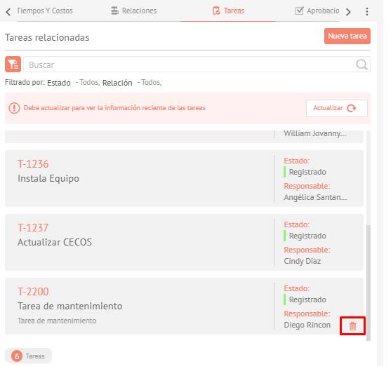
On the Tasks, in the case edit, you can delete tasks by clicking the icon.
⚐ Note: It is only possible to delete tasks that have been created manually and are in an initial state.
Task Times
The fields Duration, Start Date, End date, Actual Start Date and Actual End Date, along with the task time table, behave differently depending on whether or not the selected model has a time set in the ASMSAdministrator. View Times.
⚐ Notes:
- Once the time fields or time table are displayed in the task, they remain in view for the rest of their lifecycle.
- When you change the model, the task behaves like a new record: times and progress are cleaned up and calculated according to the time defined for the selected model.
Model with no time set up
Progress begins to advance when the task start date is reached, as long as the parent case’s calendar is active, and stops counting only when the record is closed.
After saving, the fields Duration and Start Date They remain editable as long as the task remains in the initial state.
Actual dates based on status change
The fields Actual Start Date and Actual End Date They are filled out automatically and do not allow editing:
| Change of status | Result |
|---|---|
| From the initial state to an intermediate state | Actual Start Date records the date and time of the change; Actual End Date remains empty; the fields Duration, Start Date and End date are blocked. |
| From an intermediate state to the final state | Actual End Date records the date and time of the change. |
| From the initial state directly to the final state | Actual Start Date and Actual End Date they record the date and time of the change. |
Model with Timer Set
When the model has a timer defined, the time information appears in the task when it reaches the initial state set on that timer. Before that point, the fields and table remain hidden and worthless in the database.
Progress advances when the task enters the initial state configured in the task timer, provided that the parent case’s calendar is active and the current state is marked for counting within the configured timer. Progress stops when the record moves to a state that is not marked for counting, when it reaches the end state of the stopwatch, or when it reaches the end state of the task.
| Field | Value |
|---|---|
| Duration | Time Configured for the Model, is displayed when the task enters the initial state set on the stopwatch. |
| Start Date | It is populated with the current date of the change in the task, when the task enters the initial state set on the stopwatch. |
| End date | Calculation between the duration, the starting date and the calendar of the parent case. |
| Actual Start Date | The first change of status of the task is carried out. |
| Actual End Date | It is completed when the task enters the final state set in the model stopwatch. |
| Time table | Progress is progressing according to the states marked for the count and the calendar of the case; the estimated date coincides with the End date and the actual date coincides with the Actual End Date |
The fields Duration, Start Date and End date are shown blocked.
Paused time and date recalculation
When the task moves to a state that is not marked for counting, progress and time stop, and the stopwatch reports the paused time. When you enter a state marked for counting again, progress continues from the cumulative value and fields End date and Estimated Date They are recalculated according to the duration of the pause and the timing of the parent case.
If the record goes to an end state, the time, progress, end date, and estimated date retain their values, and the paused time message disappears. See Paused times.
Time and progress updates
On the Details of the task, clicking the option to refresh time refreshes the time and progress presented in that tab, along with the progress displayed below the task status.