


The action Send mail, available when you set up a rule, allows you to notify defined recipients by email each time the rule is triggered.
Configure the Email Template
1. In the rule edit window, within the Select Actions, select the action Send mail and click on it to open the mail template.
2. In the field For, enter one or more recipients’ emails; this is a required field. Optionally, enter copied recipients in the CC, or click CCO to enable the blind copy field.
3. Enter the subject of the email and, in the Tags, select the available tags to include event information in the subject or body of the message. The available tags depend on the event configured in the rule; see the full list at Manage Rules.
4. Compose the content of the email in the rich text editor. The editor allows you to apply formatting (bold, italics, underline, strikethrough, text and highlight color, alignment, lists, tables, links, and images) and insert HTML.
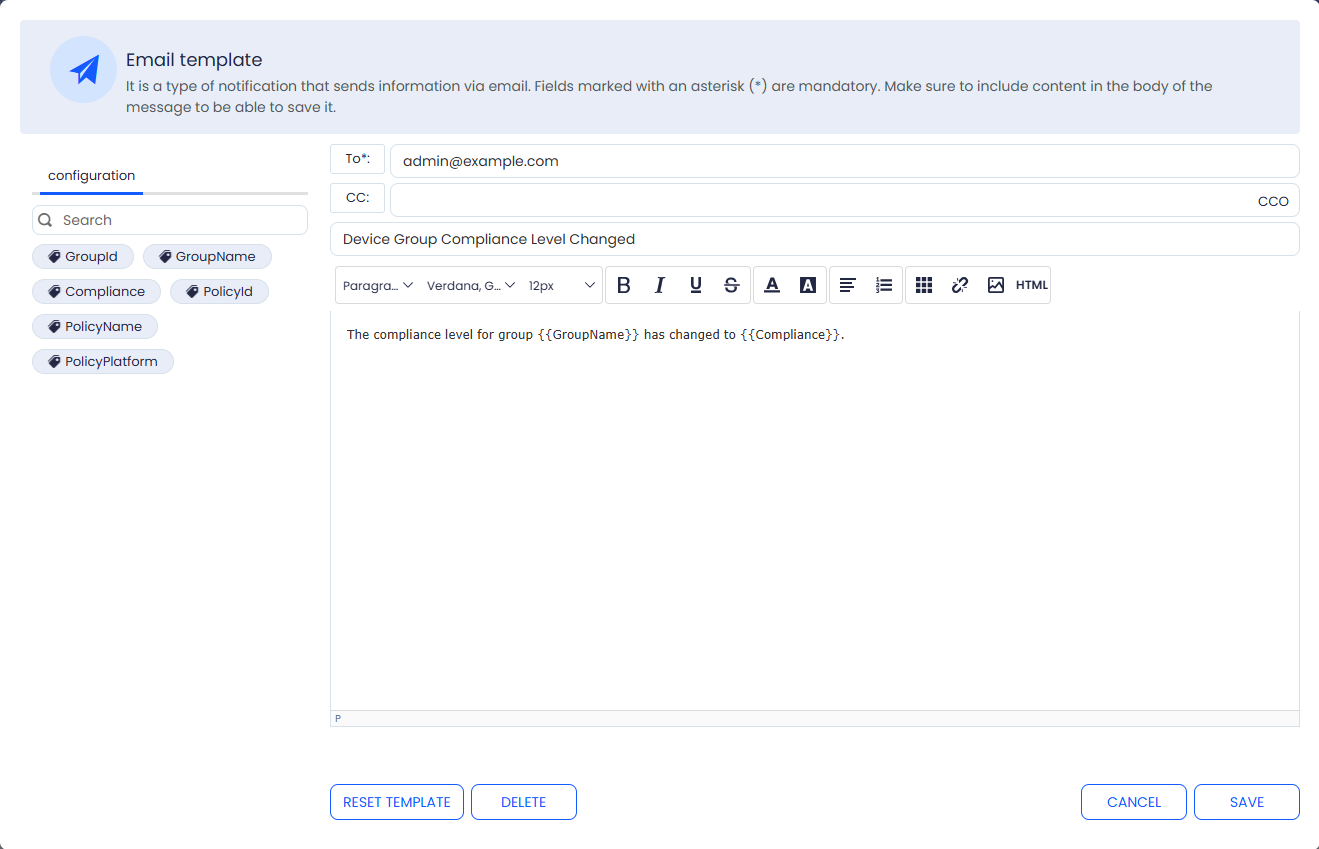
⚐ Note: The body of the message is mandatory; it is not possible to save the template if the content is empty.
5. Click the Save to confirm the template, or in Reset Template to discard the changes and revert to the default content.
Description of the Labels
DEFINICION: ❯ Cambio en el nivel del grupo de cumplimiento
| Technical field | Description |
|---|---|
| GroupId | Unique identifier of the group. |
| GroupName | Device group name. |
| Compliance | Compliance status with the evaluated policy. |
| PolicyId | Unique internal identifier for the policy. |
| PolicyName | Readable name of the configured policy. |
| PolicyPlatform | Objective operating system of the policy. |
DEFINICION: ❯ Nueva vulnerabilidad detectada
| Technical field | Description |
|---|---|
| CveId | Unique internal identifier of the vulnerability registry. |
| Cve | Public CVE code of the vulnerability. |
| Severity | General risk level: Low, Medium, High or Critical. |
| Published | Date of initial publication of the vulnerability. |
| Cwe | Type of software weakness according to CWE standard. |
| Description | Summary of the security issue and its potential impact. |
| DevicesCount | Total number of devices that have the vulnerability. |
| DevicesName | Names of computers in inventory or network. |
| Cvss30_BaseScore | Base score from 0.0 to 10.0 according to CVSS v3. |
| Cvss30_BaseSeverity | Textual severity of the CVSS v3 score. |
| Cvss30_Vector | CVSS v3.x string used to calculate the score. |
| Cvss30_ImpactScore | Subscore that measures the impact of the attack (CVSS v3). |
| Cvss30_ExploitabilityScore | Subscore that measures ease of exploitation (CVSS v3). |
| Cvss20_Score | Base risk score from 0.0 to 10.0 (CVSS v2). |
| Cvss20_AccessVector | Attack access medium: local, adjacent or network (CVSS v2). |
| Cvss20_AccessComplexity | Difficulty exploiting the vulnerability (CVSS v2). |
| Cvss20_Authentication | Authentication required to exploit the flaw (CVSS v2). |
| Cvss20_IntegrityImpact | Data integrity or configuration impact (CVSS v2). |
| Cvss20_AvailabilityImpact | Impact on service availability (CVSS v2). |
| Cvss20_ConfidentialityImpact | Impact on confidentiality of information (CVSS v2). |
DEFINICION: ❯ Nueva vulnerabilidad detectada en dispositivos
| Technical field | Description |
|---|---|
| DeviceId | Unique identifier internal to the device. |
| DeviceName | Name of the equipment in inventory or network. |
| DeviceHardwareHash | Unique technical footprint generated from the hardware. |
| DevicePlatform | Device operating system. |
| DeviceGroupId | Unique identifier of the device group. |
| DeviceGroupName | Name of the group to which the device belongs. |
| DevicePolicyId | Unique identifier of the applied policy. |
| DevicePolicyName | The name of the policy applied to the device. |
| ProgramVendor | Manufacturer or supplier of the software. |
| ProgramSignature | Signature or trusted identifier of the software. |
| ProgramVersion | Detected version of the software on the device. |
| CveId | Unique internal identifier of the vulnerability registry. |
| Cve | Public CVE code of the vulnerability. |
| Severity | General risk level: Low, Medium, High or Critical. |
| Published | Date of initial publication of the vulnerability. |
| Cwe | Type of software weakness according to CWE standard. |
| Description | Summary of the security issue and its potential impact. |
| Cvss30_BaseScore | Base score from 0.0 to 10.0 according to CVSS v3. |
| Cvss30_BaseSeverity | Textual severity of the CVSS v3 score. |
| Cvss30_Vector | CVSS v3.x string used to calculate the score. |
| Cvss30_ImpactScore | Subscore that measures the impact of the attack (CVSS v3). |
| Cvss30_ExploitabilityScore | Subscore that measures ease of exploitation (CVSS v3). |
| Cvss20_Score | Base risk score from 0.0 to 10.0 (CVSS v2). |
| Cvss20_AccessVector | Attack access medium: local, adjacent or network (CVSS v2). |
| Cvss20_AccessComplexity | Difficulty exploiting the vulnerability (CVSS v2). |
| Cvss20_Authentication | Authentication required to exploit the flaw (CVSS v2). |
| Cvss20_IntegrityImpact | Data integrity or configuration impact (CVSS v2). |
| Cvss20_AvailabilityImpact | Impact on service availability (CVSS v2). |
| Cvss20_ConfidentialityImpact | Impact on confidentiality of information (CVSS v2). |