


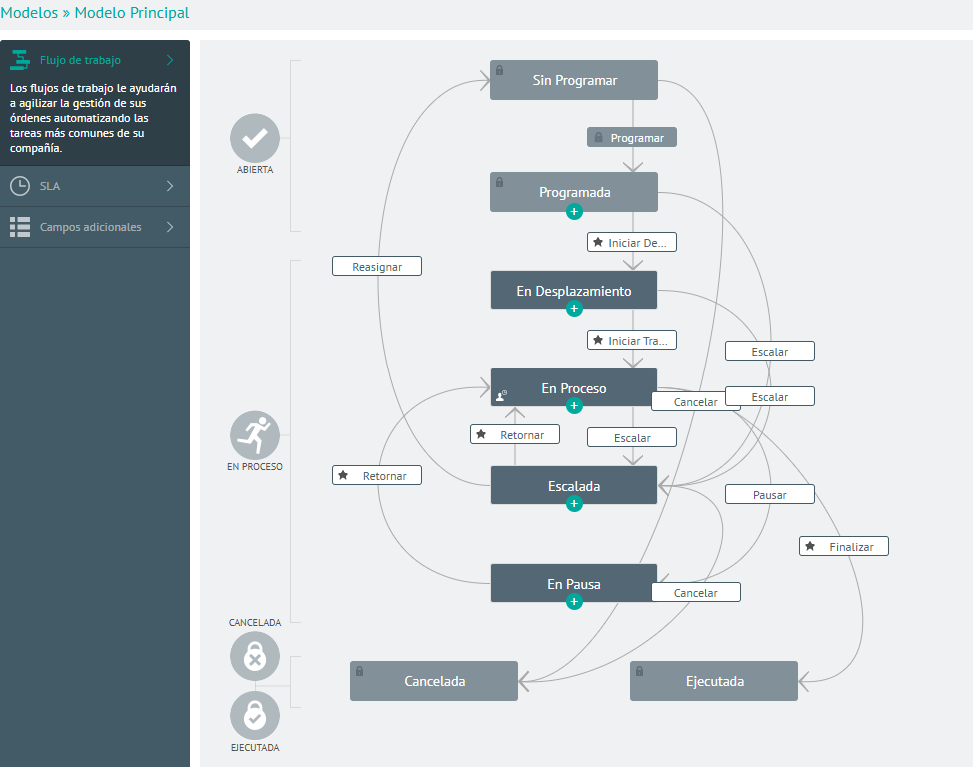
The customer-designed model for the management and service of work orders from the AFLS web console, configures the workflow and determines the life cycle of work orders. Each activity in the workflow will be a step that the field specialist from the mobile console must carry out until a job is completed.
A workflow is made up of states, sub-states, activities, transitions that define the procedure.
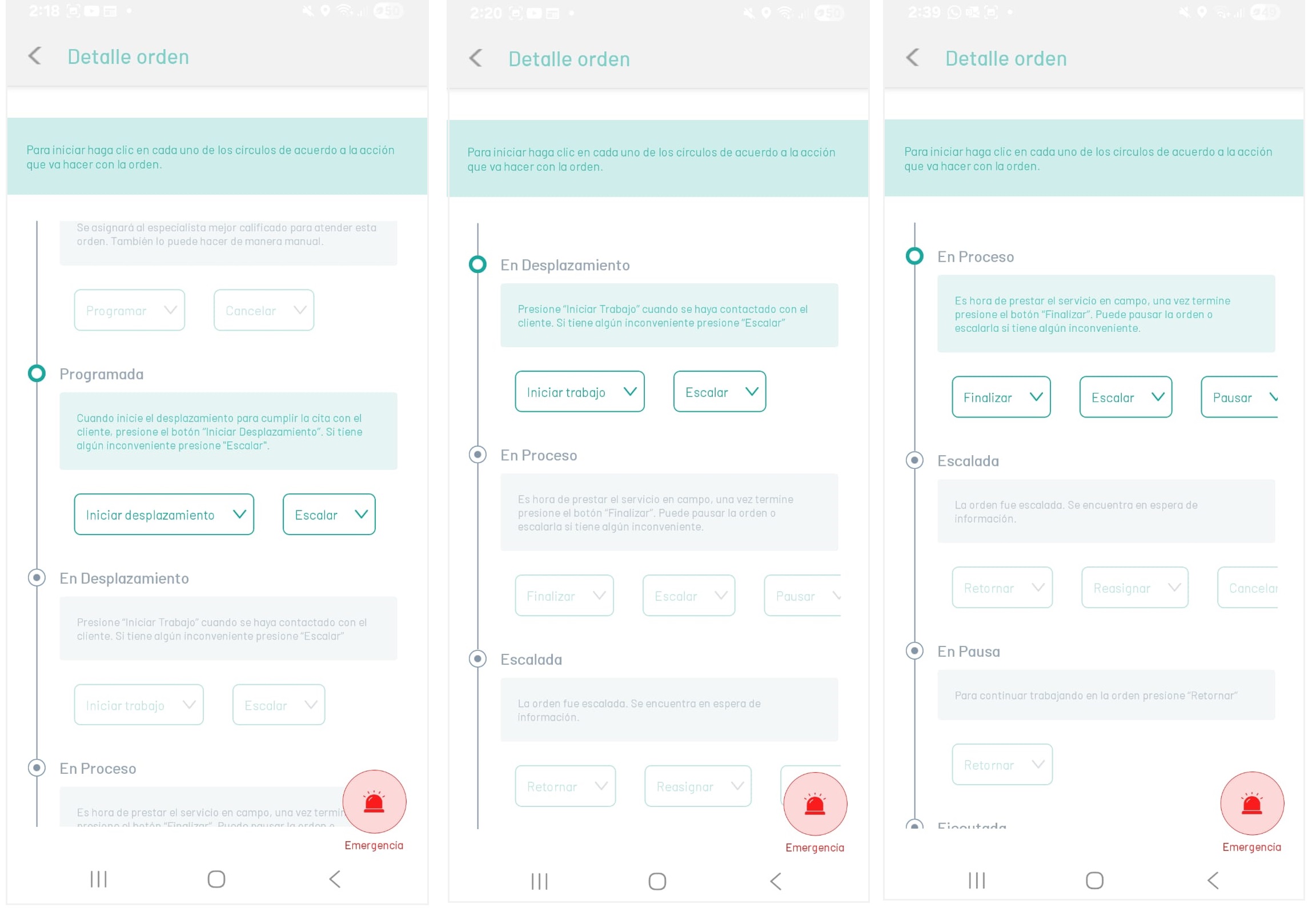
From the AFLS Mobile console, the field specialist will attend to the work order following the previously designed flow.
Below you can expand on the most relevant concepts:
Model
Grouping of characteristics common to various services. Generally within organizations, services are provided under a similar parameterization in terms of workflow and additional fields for orders.
States
Stages for the execution of the order. In the configuration of the Aranda FIELD SERVICE workflow there are three main phases or states that summarize the steps of order execution:
- Open: This status corresponds to orders that have not yet been assigned to a specialist, they are rescheduled or newly created orders, and orders assigned to a specialist but that have not yet started their execution.
- In process: This status includes all the steps that the field specialist must execute to perform a task. The sub-states defined within this state will guide the specialist step by step. Within this state you can create any sub-states you want, however, it is important to keep the process simple.
- Executed: The work order ends in this state, with two possible sub-statuses: executed or canceled.
Sub-states
The field specialist receives orders in the “In Process” status and at this point the sub-statuses serve as a guide for the execution of an order. The order lifecycle is governed by sub-statuses and their transitions. When creating a sub-state, the administrator can configure different options that allow the model to be adapted to the business process.
| Sub State | Description |
|---|---|
| Unscheduled | This sub-state is typical of the system. Any transition that comes to this sub-state will cause the engine to automatically take care of selecting a new date and time, as well as a new specialist who can handle the order. |
| Scheduled: | This sub-state is typical of the system. An order can go from “unscheduled” to “scheduled” status through two events: through the assignment engine, where the tool schedules the order, or through manual scheduling. |
| Canceled: | This sub-state is specific to the system. It corresponds to a terminal state. When the order reaches this status, it indicates that the work was not performed. |
| Executed: | This sub-state is specific to the system. It is a terminal status that indicates that the order was successfully completed. |
Transitions
Transitions are represented by arrows or paths that go from one substate to another. Transitions have an additional context and that is that they become “buttons” that can be used by field specialists or agents on the web to move a work order from one state to another.
Reasons
The reasons will be requested from the field specialist when the status of a work order changes.