


Catalog Synchronization
What is catalog synchronization for? It allows you to keep the language, region, newsletter, product, ServiPack, and patch information that ADM uses for update management current, through weekly scheduling, immediate on-demand execution, or the retry of a failed step, with complete visibility into the progress of the process.
Accessing Settings
1. Enter the screen Configuration and select the Application Catalog, in the ADM from the main menu.
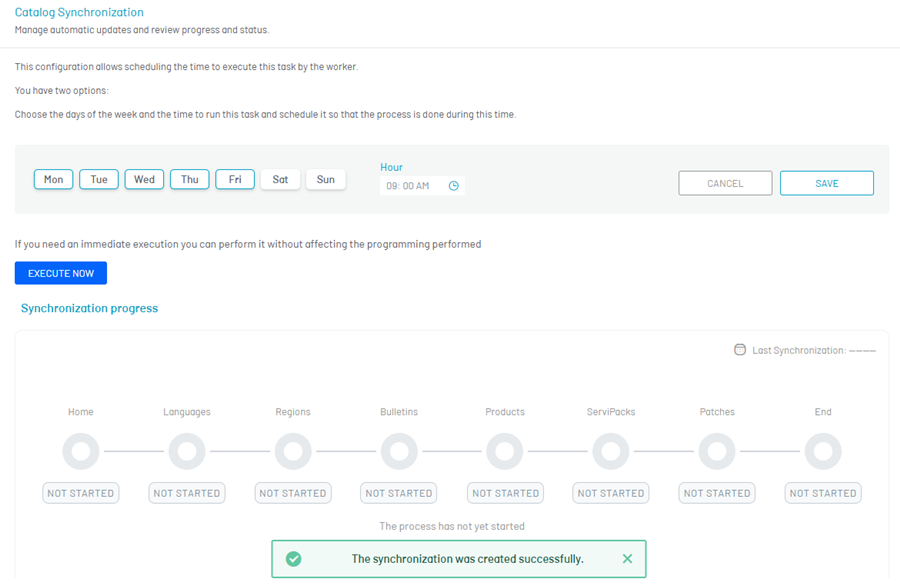
If no schedule has been set up, and no synchronization has ever been run, all progress steps are displayed in a NOT STARTED; The Field Last Sync appears empty and the system indicates “The process has not yet begun”.
Schedule the download of the catalog
How do I schedule the automatic download of the catalog? By selecting the days of the week and the time at which the task will be executed.
1. Select one or more days (Mon to Sun) and define the Hour in that it requires running the synchronization.
2. Click SAVE to apply the schedule, or in CANCEL to discard changes made to it.
⚐ Note: The CANCEL it only discards unsaved changes to the schedule; it does not cancel a synchronization that is running.
⚠ Warning: Select at least one day before saving. If you try to save without any days selected, the system displays the message “You must select at least one day.” and does not apply the changes.
Run the sync immediately
How to force a synchronization without waiting for the schedule? With the RUN NOW, available without affecting the schedules already configured.
1. Click RUN NOW.
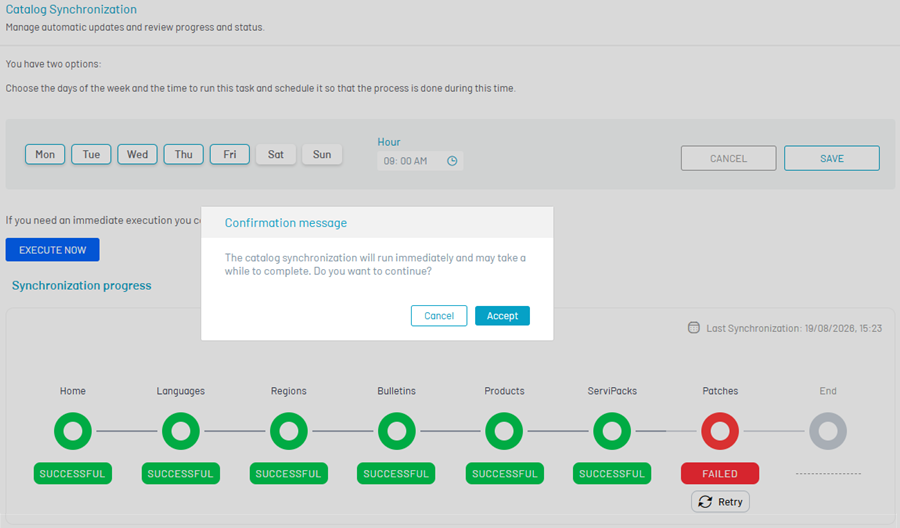
2. The system requests confirmation by the message: “The catalog sync will run immediately and may take time to complete. Want to continue?”. Click Accept to start the process or in Cancel to skip the action.
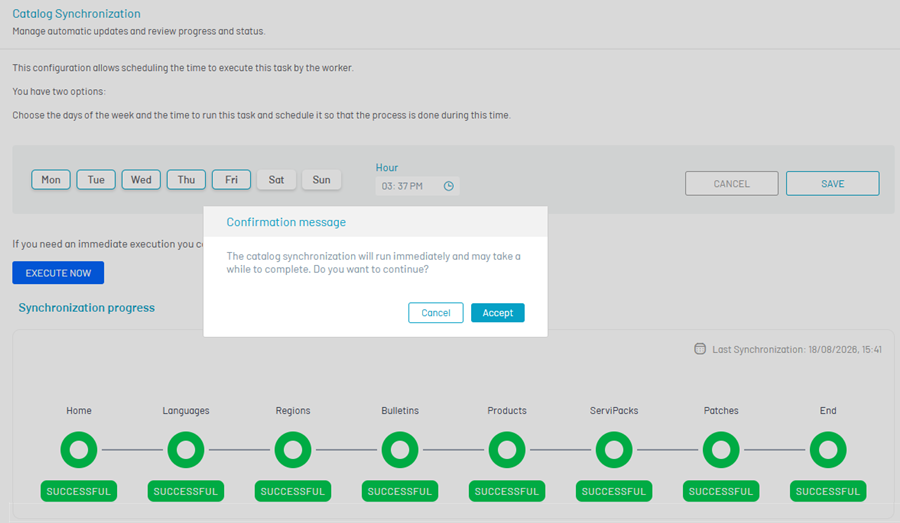
⚐ Notes:
- RUN NOW It does not modify or replace the configured schedule.
- If a new version of the catalog is not available, the progress flow does not start.
- The button loading icon remains visible for only 30 seconds; after that time, the button returns to its active state even though the synchronization is still in progress. Check the progress indicator for the actual progress of the process.
- RUN NOW it remains always active, even with a synchronization in progress. The system prevents the execution of a second synchronization in parallel until the current one is completed, without notifying the user that the new request was skipped.
View sync progress
How is the progress of a synchronization validated? Through a progress indicator made up of eight sequential steps: Beginning, Languages, Regions, Newsletters, Products, ServiPacks, Patches and Final.
Each step can be found in one of the following states:
| State | Description |
|---|---|
| NOT STARTED | The step has not yet been executed. |
| PROCESS | The step is running right now. |
| SUCCESSFUL | The step ended successfully. |
| JUDGMENT | The step ended with an error and requires retry. |
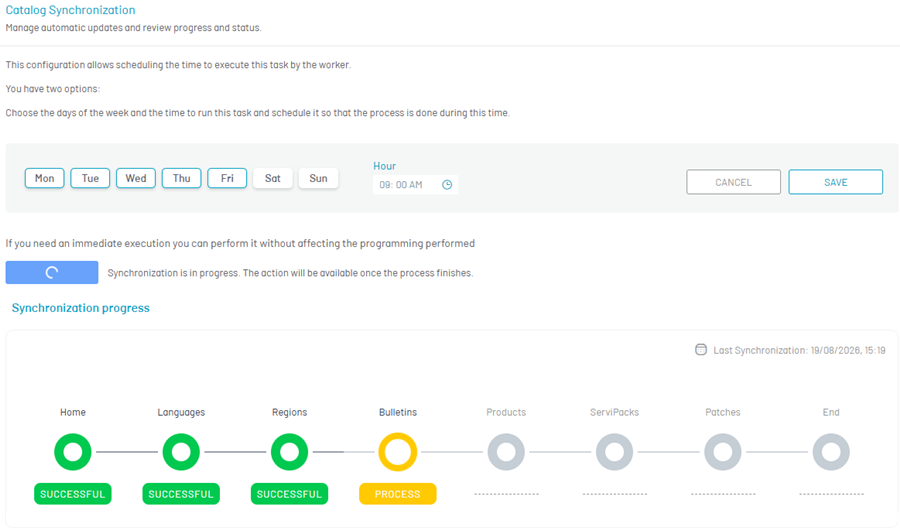
At the top of the indicator, the Last Sync Displays the date and time when the most recent process ended.
⚐ Notes:
- While the screen remains open and the process is still active—that is, the Final it has not yet reached SUCCESSFUL and no step is found in JUDGMENT— Progress is automatically updated every 30 seconds, without the need to refresh the page.
- If the worker service stops during synchronization, the process does not resume automatically: it remains in the last processed step until a new execution is forced with RUN NOW or the next scheduled execution is fulfilled, whichever comes first.
Retry a failed sync
What to do when a step ends in JUDGMENT? Retry from the same progress indicator.
1. Locate the step in status JUDGMENT and click Retry.
2. The system requests confirmation using the same message used in Run Now: “The catalog sync will run immediately and may take time to complete. Want to continue?”. Click Accept to retry or in Cancel to skip the action.
⚐ Note: If a new version of the catalog is not available, the retry resumes the process from the step that failed onward; the steps already in SUCCESSFUL they are not run again.